
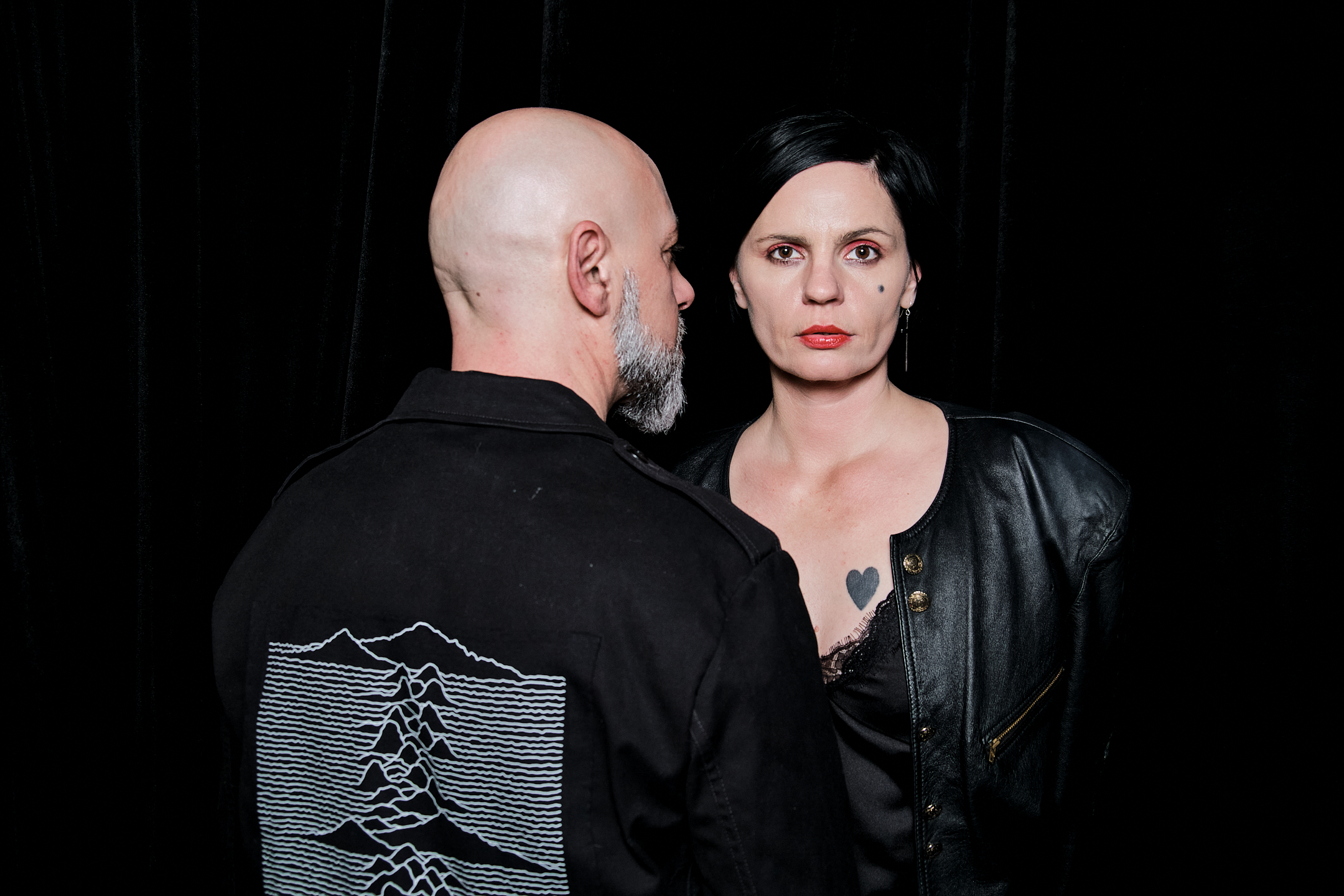

Years of Denial are a duo that has steadily strengthened their presence on the industrial scene in recent years. Their music is built on sharp rhythms and minimal structures, but live it unfolds differently — denser and more intense. I spoke with Years of Denial about the stage, the studio process, touring, and how they see the project evolving from here.
How did the name "Years of Denial" come about? Has its meaning changed for you over time?
The name was created by Jerome in 2015 to commemorate the 100th year of denial of the Armenian Genocide. This subject resonates deeply with him, as he is half Armenian. The meaning of the name hasn't changed for us, especially in light of the ongoing crimes that continue to this day. There can be a different interpretation of the name, which is quite intriguing. Living in denial is something we all understand and have likely experienced at some point in our lives.

What is the stage for you — a tool of impact or a space for experimentation?
Playing live on stage is one of the main reasons we do what we do. The shared physical experience creates a sense of unity, capturing the power of the present moment. It's extremely cathartic. We are not just a studio project; our music needs to transcend and come to life. With Barkosina's background in theatre and performance art, she effectively uses the stage as a powerful tool of impact, whether it's encouraging women to take the lead or playing with social commentary. Jerome loves to experiment with sound effects, using dub mixology to manoeuvre the audience's mind. We both try to push the boundaries to create something memorable.


Your recordings sound cold and sharp, but live, they feel more intense. Do you consciously build in that difference?
We like the idea of creating a record that you can listen to at home while also delivering a live show that transforms into a more dynamic and energetic experience. We want to offer an album that achieves both. Performing live is an art form in itself, involving stage presence, direct engagement with the audience, a sense of urgency, and the effective use of space, lighting, and sound. There's a lot to consider and work with in this process, and we pay attention to it; it's important for us.

How do you see the state of the industrial scene today — a solid movement or temporary attention?
It's difficult to define what "industrial" means today. There are still some decent noise and EBM acts, but it seems the world is turning a blind eye to them. Looking back, it used to represent a solid, radical movement with influential acts like Throbbing Gristle, Cabaret Voltaire, Einstürzende Neubauten, Esplendor Geométrico, SPK, to name a few. However, the current scene today is increasingly nuanced and complex, evolving in new directions, giving rise to numerous subgenres. We are now witnessing a culture of "anyone can make it," driven by desire for popularity, visibility, overexposure online, and an unhealthy obsession with self-image, rather than a genuine commitment to an artistic and political movement. What we often witness today is a quick fix, a hit of dopamine, music for fitness rather than music with depth or a manifesto.
People used to gain recognition because they had talent, skill, originality, or a significant impact. Today, recognition often comes simply from being visible. As a result, we see many individuals finding success on social media platforms, building their presence as brands within a commercial framework. Others remain dedicated to fostering strong, community-driven movements that prioritise the music itself over image or online metrics, and these are still thriving on healthy grounds, acts like Orphx, Puce Mary, Ancient Methods, Hypnoskull, Codex Empire, Pharmakon, or Dame Area, to name a few. They are not begging for attention; they simply deserve our attention for pushing the limits of the genre.

When you write music, do you think more about its physical impact or about the overall concept of a release?
We discovered our concept and developed our own genre, which we call Suicide Disco, and we continue to explore it. Music is physical, and the impact is important, but we don't necessarily overthink it. It comes naturally to us now.

If a track works well live but feels too straightforward to you, do you keep it as it is or rework it?
We avoid overworking our tracks and focus more on the flow of the live set. Instead of stopping after each track, like some bands do when they pause to talk, we prefer to have zero interruptions and keep playing continuously. Our main emphasis is on creating smooth transitions between tracks.
In the studio, do you have clearly defined roles, or is everything decided in the process?
We work closely together, constantly sharing and feeding off each other's ideas and skills. Jerome is the tech brain behind the project, while Barkosina excels in creative direction and lyricism. We like to work in proximity; well, our home is literally our music studio. There is nowhere to escape to.

Does constant touring strengthen the project or wear it down over time
Touring is essential for our survival as artists; that's how we make a living and for connecting with people. We love meeting our fans and sharing the stage with fellow musicians. It's very needed after spending so much time in the studio. For us, touring definitely strengthens the project. We feel inspired every time we return to the studio; it fuels new ideas and motivates us to continue our work.
Are there countries or cities where audiences seem to understand your material especially well?
Our records are now reaching a broad audience, and we're seeing interest from almost every corner of the globe. When it comes to live shows, the energy we receive from our audience is particularly strong in Spain, Germany, Latin America, and even Asia.


Is it important for you that listeners understand the lyrics literally, or is the general meaning enough?
Barkosina is influenced by confessional poetry and literature, making it quite essential for her to be heard and understood. You can hear it on the recordings, the voice is clear, it stands out. The use of spoken word enhances the narration, the meaning, and delivering the lyrics in English, a global language, amplifies the impact, even though Years of Denial is a French-Czech collaboration.

In live performances, what matters more to you — control or risk?
Definitely both, in terms of the mental state and the preparation of the live set, we like to be in control, but during the show, we like to take risks, depending on the sound and the energy in the room.

Have there been moments when you seriously considered pausing or ending the project?
Sadly, yeah, we had a moment not that long ago. There was a significant imbalance between the time and energy we invested in our work and the financial and mental rewards we received. We felt exhausted and struggled to find the motivation to continue. It's heartbreaking to give your best and still feel unable to sustain it. YOD is not a hobby; it's a job. Any artist can relate to what we're talking about. Current conditions for creative people are very tough. The rapid changes in musical styles and the constant demand for visibility make it even more difficult. We see ourselves as musicians, not content creators. The ecosystem of the industry is totally fucked right now. Many producers feel this way; everyone knows that DJs can demand ridiculous amounts of money for playing someone else's music, while producers are barely getting by. However, we are grateful because this situation has opened our eyes. We want to move away from toxic environments and surround ourselves with spaces that are more welcoming and artistic, and luckily, that spirit is still alive.

If you remove genre labels, what is Years of Denial to you?
YOD is pretty much a way of life, or has been for the past decade. It's like a laboratory, an experiment between two people, exploring creativity, intimacy, anxieties, isolation, freedom, and the ongoing quest for meaning.
What is the next step for Years of Denial?
Currently working on our next album, Suicide Disco Vol. 3, which should be out in October on Veyl Records; there will be a new, exciting live show, and we are ready to tour the shit out of this album.


Socials:
Bandcamp - yearsofdenial.bandcamp.com
Soundcloud - soundcloud.com/yearsofdenial
Instagram - instagram.com/yearsofdenial
Facebook - facebook.com/yearsofdenial
Current booking agency altar:
antonia@altaragency
Contact:
yearsofdenial@gmail.com
Photography:
Aylo
Larry J
Alberto Lora
Bérangère Tiran
HDRX Studio
Matt Favero
LYON
Sebastien Cortiz
Dem Erika
Varga Laszl
Text by Denis Veber / Thanks to Years of Danial — Daze Team